It was a late spring day when I visited Tokyo for the first time. I had just landed at Narita and was filled with unbridled anticipation for a country where I expected to find lifelong inspiration on every street corner. Whether for the work in the kitchen, at the desk or simply for the way I sort my socks. But I was also aware that too many expectations and supposed prior knowledge could cloud my fresh, curious gaze, so I tried to be as unbiased a traveller as possible and didn’t read any travel guides or other literature about the country from the moment I knew I would be travelling there. This was evident at the airport when, after my arrival, I asked for a ticket ‘to Tokyo’ at the ticket counter (and not Shinjuku, Ginza or whichever of the 23 areas that make up the prefecture I wanted to go to). Nevertheless, a little later I made it to the agreed meeting place, a Café close to the Shinsen-Station, where a friend came to pick me up. We took my luggage to the accommodation and then visited Yoyogi Park. Jetlagged, all my impressions were muted and intensified in equal measure. The tranquillity with which this bustling city spread out around me still echoes within me today, years later. The same goes for the moments of a very different kind of loneliness, which I would later experience on my travels to other parts of the country. In a state of exhilarated tiredness, I followed my friend through the park to Meiji Shrine. In addition to the usual crowd of tourists, a wedding procession was also taking place at this Shinto place of worship. Arranged by generation, a group walked reverently through the gate and out of sight, as if there were no other people around them. This process took at least a quarter of an hour, but it felt completely indefinite in terms of time. They simply walked. When the last family member had left the site, I stepped under the gate into the shrine. I had previously visited sacred spaces of the Christian, Zoroastrian, Islamic, Jewish and Buddhist faiths, but this was my first time in a building dedicated to Shintoism.
Standing beneath the entrance, my untrained eye could not yet discern from the architecture of the pillars or the construction of the roofs whether this was a Buddhist or Shinto place of worship. But as soon as I stepped into the courtyard, this fundamentally different conception of faith and ultimately worldview struck me. Even an illiterate person like me could not overlook the obvious feature of this architecture: the centre was empty. Where other temples have a statue, a cross or an altar, here there was an empty space. Sure, smaller structures for offerings would later be found at the edges, but the actual centre of this open building was an untouched, empty space. Visitors stood at the edges of this place and clapped (their wishes?) into the void, rather than towards a representative (symbol or figure) of a deity. And they did not enter the space either. The centre is and remains empty.
At that moment, I realised how strongly my thinking is oriented towards concepts such as essence or identity. The identity-forming, immutable core of a thing. The thing itself. That which is identical with itself. That which corresponds to another thing. The house. The body.
I went outside and decided not to think of the white space as a consequence. Not as what remains when everything else is done. Not as a gap between two forms that are actually meant. Not as a void that needs to be filled. It eludes fixation, like something that only takes shape as it slips away. It also eludes possessive access. No core, no essence, but an echo of what shows itself and at the same time withdraws. Perhaps this restraint is itself another measure of ... what? I went to the nearest drinks machine, where my friend played a funny little game with me, dispensing an iced coffee that turned out to be a hot drink after all.
The Book of Tea
by Kakuzo Okakura
Title: The Book of Tea
Author: Kakuzo Okakura
Release Date: January 1, 1997 eBook #769
Most Recently Updated: January 17, 2016
Language: English
Credits: Produced by Matthew, Gabrielle Harbowy, and David Widger
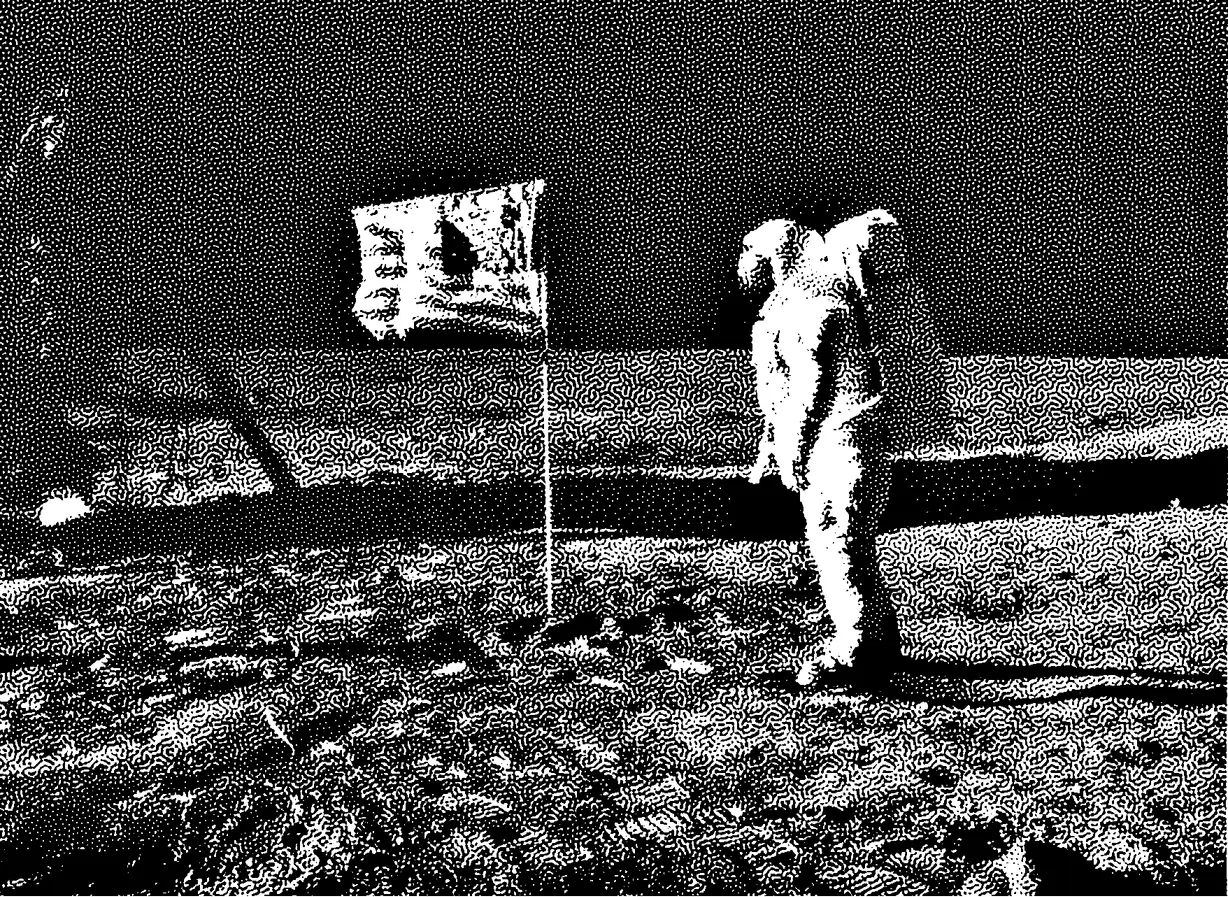
Images: Neil Armstrong, Buzz Aldrin on the Moon with the American Flag, 1969. Gift of Mary and Dan Solomon, 2016. Image available at: Metropolitan Museum of Art