We live in the age of scale. In economic ventures, scalability has long been the guiding principle on which new enterprises are founded; whoever masters the challenges of scaling is promised success. More interesting, however, are the observations that can be made across disciplines whenever something is scaled.
Whatever is scaled inevitably changes. The morphology of insects versus that of humans. The differing stability of small and large load-bearing structures in architecture. The behaviour of algorithms that perform well on small datasets yet falter when applied to billions of inputs. The way biological systems (cells, organs, ecosystems) shift their dynamics as they grow. The contrast between quantum behaviour and classical mechanics. In digital graphics, the notion of scalability is commonly treated as resolved: vector graphics are assumed to be infinitely and losslessly scalable. Mathematically this is correct; the computational model of points, curves, and transformations retains its internal precision at any size. Yet, in practice, vectors are always realised within systems that impose discrete constraints. Every display, printer, and imaging device ultimately renders to a raster. Scaling therefore entails rounding operations and antialiasing strategies that alter the appearance of shapes, particularly at small sizes where a single pixel represents a significant portion of form. Software environments introduce further divergence, using distinct coordinate systems, unit definitions, and conversion routines. Moving a vector between applications can result in measurable shifts caused by floating-point limitations and incompatible Bézier implementations. In typography, the discrepancy is heightened: glyph outlines include instructions (hinting) that govern their behaviour at specific sizes, which are lost when text is converted to outlines. Thus, even in fields predicated on precision, scale introduces qualitative change not as an exception but as a structural condition.
The phenomenon is not exclusively digital. In metal type, the division of labour between punchcutter and type designer already introduced a separation between design and realisation; a typeface was not necessarily conceived at the size at which it was cast and printed. Yet this differential has expanded significantly with the scalable digital design environment. A single letter may now be inspected, modified, and evaluated at magnifications inconceivable in previous centuries, or designed at a scale entirely detached from its eventual use. The optical adjustments that once had to be embedded in size-specific cuts have re-entered contemporary practice in a different form: optical sizes, especially in variable fonts, enable the modulation of weight, contrast, proportions, and detailing in response to use.
The Epic of Gilgamish
by Stephen Langdon
Title: The Epic of Gilgamish
Author: Stephen Langdon
Release Date: July 23, 2006 eBook #18897
Language: English
Credits: Produced by Jeroen Hellingman and the Online Distributed Proofreading Team at pgdp.net
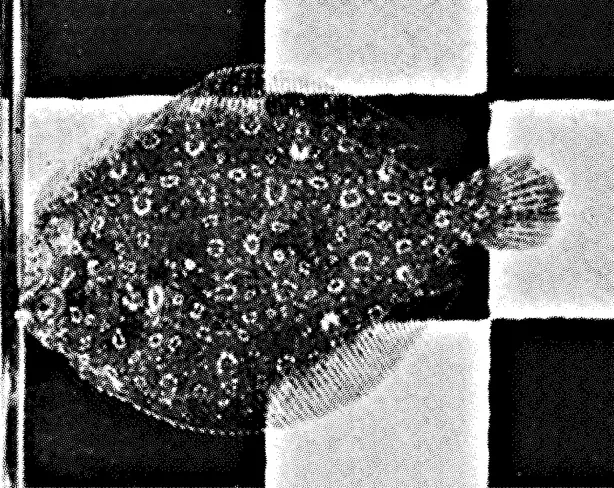
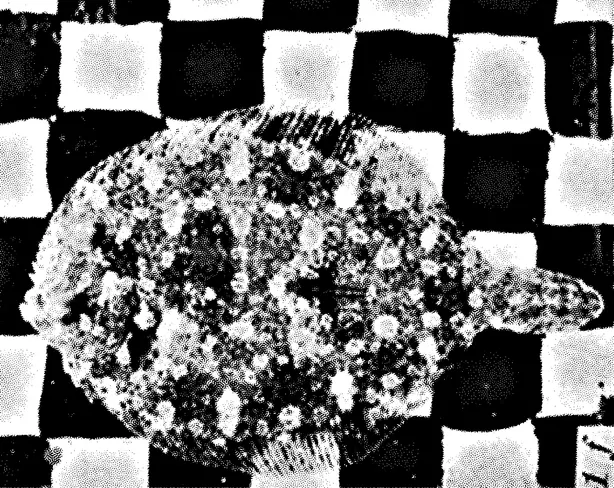
Images: Francis Bertody Sumner, Flatfish Camouflage Experiments from Journal of Experimental Zoology, 1911. Public Domain. The Public Domain Review