What are we but areas that move between areas, perceiving areas, dividing areas, with the help of areas, into more areas? Lines, on the other hand, lead a ghostly existence: in their terrible conspicuousness, they are omnipresent and yet we cannot perceive them. All we see are moments of division, are the edges where the one tips over into the other in order to remain the same. In praise of imagery: Imagination, pencils and all other instruments of visualisation eventually help us to create these compressed surfaces. Escape lines of experience, fault lines of sensation, trains of thought and narrative threads: lines are essentially figures of passion.
There are many differences between texts and images, but one in particular is often emphasised: while images can be grasped in an instant, the meaning of a text can only be understood once all of the words have been registered. Accordingly, texts are often described as linear, even though, in most cases, this linearity is erratic or even fractal (with eye movements consisting of saccades). Any attempts to escape this linearity usually result in the lines becoming fragmented into more lines, except in the case of one-word readers, where the reading movement is directed towards a single word.
Although we could describe text, in contrast to images, as a medium of lines (and here the line becomes a demarcation line on all significative levels), it is images—or more precisely, the pictorial nature of the visual—that, alongside the virtual, mathematical construct, allows for manifestation of lines in the first place.
In typography, the line is both a measure and the predetermined movement of reading. Its texture depends on the harmony between letterforms, spacing, and leading. Leading determines the rhythm of the text block. Lines exist aswell inside each letter: the stress, the trajectory of the stroke, the motion shaping vector.
The WONDERFUL WIZARD of OZ
by L. Frank Baum
Title: The WONDERFUL WIZARD of OZ
Author: L. Frank Baum
Release Date: February 1, 1993 eBook #55
Most Recently Updated: December 29, 2024
Language: English
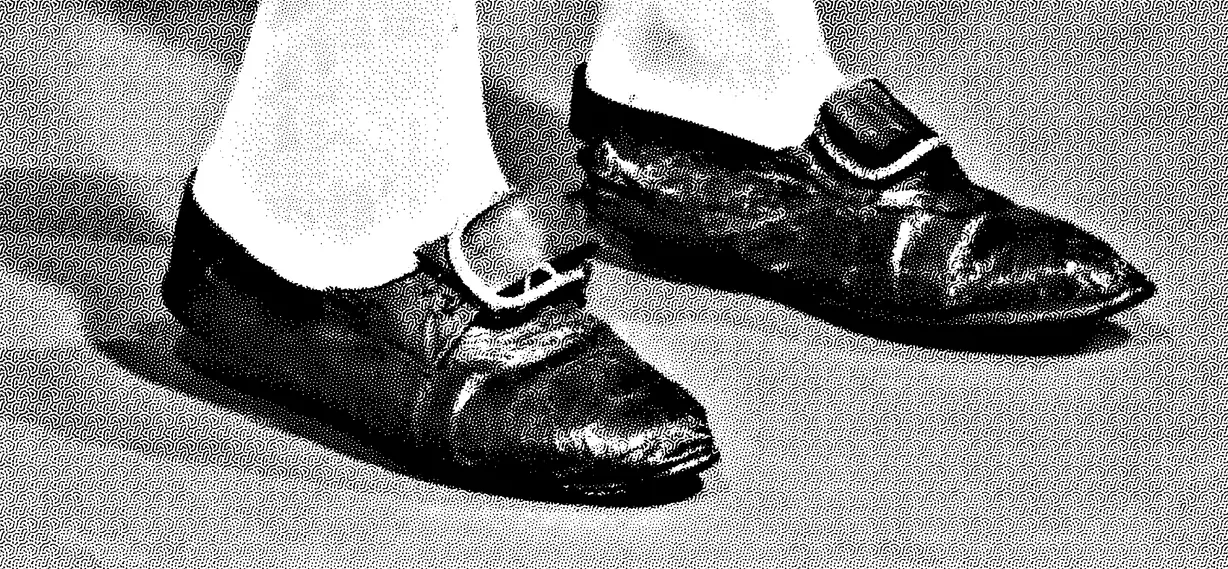
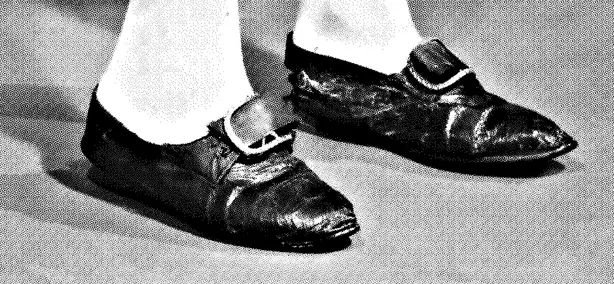
Images: Shoes, 1790–1825, Brooklyn Museum Costume Collection at The Metropolitan Museum of Art, Gift of the Brooklyn Museum, 2009; Gift of Mrs. Clarence R. Hyde, 1928. Image available at: Metropolitan Museum of Art