It does not matter what note you play. What only matters is which note follows,
a legendary trumpet player once said (in a pretty different way, but that is how I remember the quote). And also nodes are often defined more by their context than by their very coordinates. As junctions, connecting points or simply as a basic unit they fundamentally define the structure of data, the architecture of shapes. And it is only the sequence of several nodes that determines the appearance. But especially in the visual realm, they lead a dubious existence. On the one hand, they are image-forming in vector image production, making it possible to create contours and surfaces in the first place; on the other hand, they ultimately recede behind the given image.
Nodes mark the transition into the technical age by how they turn form into data. Designers and engineers already thought in terms of measurements, geometry, and even coordinate-like reasoning long before the use of computers. Letterforms were constructed, architectural drawings relied on projection, mechanical parts were dimensioned with astonishing precision. But as these constructions were “analogue”, they remained continuous. Enter the node: Forms are now discrete, shapes are a list of coordinates and continuity is produced by computational smoothing. With this comes an epistemic shift: Drawing and model are interrelated, like hands touching each other. Each hand both touches and is touched, with their roles constantly shifting. And so drawing is not merely a representation of the model, and the model is not merely the origin of the drawing. Both arise in a mutual interplay. Although drawing has never been just a medium of representation, but always also one of operation, one that forces the model into a certain order (line, proportion, grid, materiality), the introduction of nodes has given this reciprocal relationship a significant influence on authorship, insofar as it shifts slightly ‘in favour’ of the model: digital drawing can no longer not be a model, and from now on, the designer can no longer purely be a drawer but is always also a model-builder. Nodes allow form to be computed.
In typography this shift becomes particularly clear. The introduction of nodes did not simply change how letters are drawn, it changed also what a letter is. In metal or photo-type, a curve remained a continuous stroke, inferred from tools and material. In digital type design, a curve is the behaviour of a few coordination representing points and their handles. An o is no longer the oval we draw; it is a set of coordinate pairs whose tension, distribution and hierarchy determine whether the curve feels smooth, stiff, soft or mechanical. It does not matter what node you draw. What only matters is which node follows.
The Magnificent Possession
by Isaac Asimov
Title: The Magnificent Possession
Author: Isaac Asimov
Illustrator: Mort Meskin, John Walter Scott
Release Date: September 13, 2025 eBook #76871
Most Recently Updated: October 4, 2025
Language: English
Credits: Roger Frank
Original Publication: Chicago, IL: Double Action Magazines, 1940
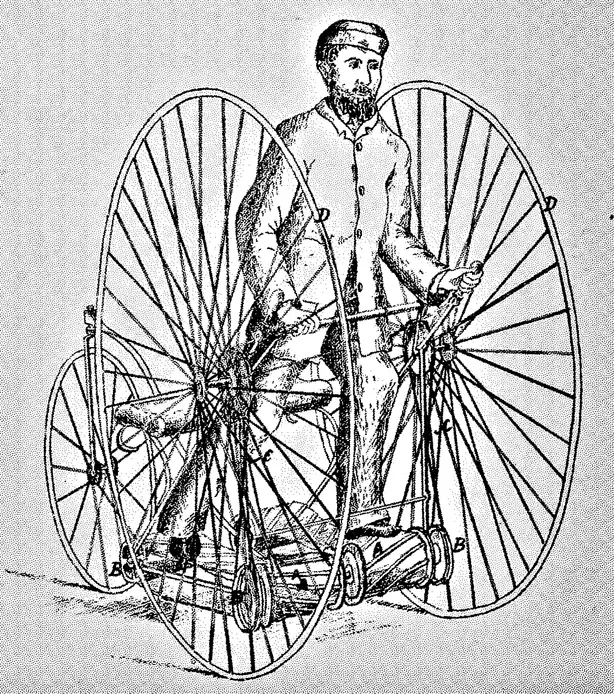
Images: Scott Pittis, Robert Pittis, a clipping from Cycling art, energy and locomotion- a series of remarks on the development of bicycles, tricycles, and man-motor carriages, 1889, Philadelphia, J. B. Lippincott. Public Domain. Wikimedia Commons